Programming systems, or
what programming language
research cannot see
Tomas Petricek, Charles University, Prague

1 INTRO - HyperCard demo - 2 TECH DIMS - Timeline 4 COMPLEMENTARY - C64 3 FORMAL - TheGamma 5 HCI - Denicek 6 CONCLUSIONS
Intro
Programming systems
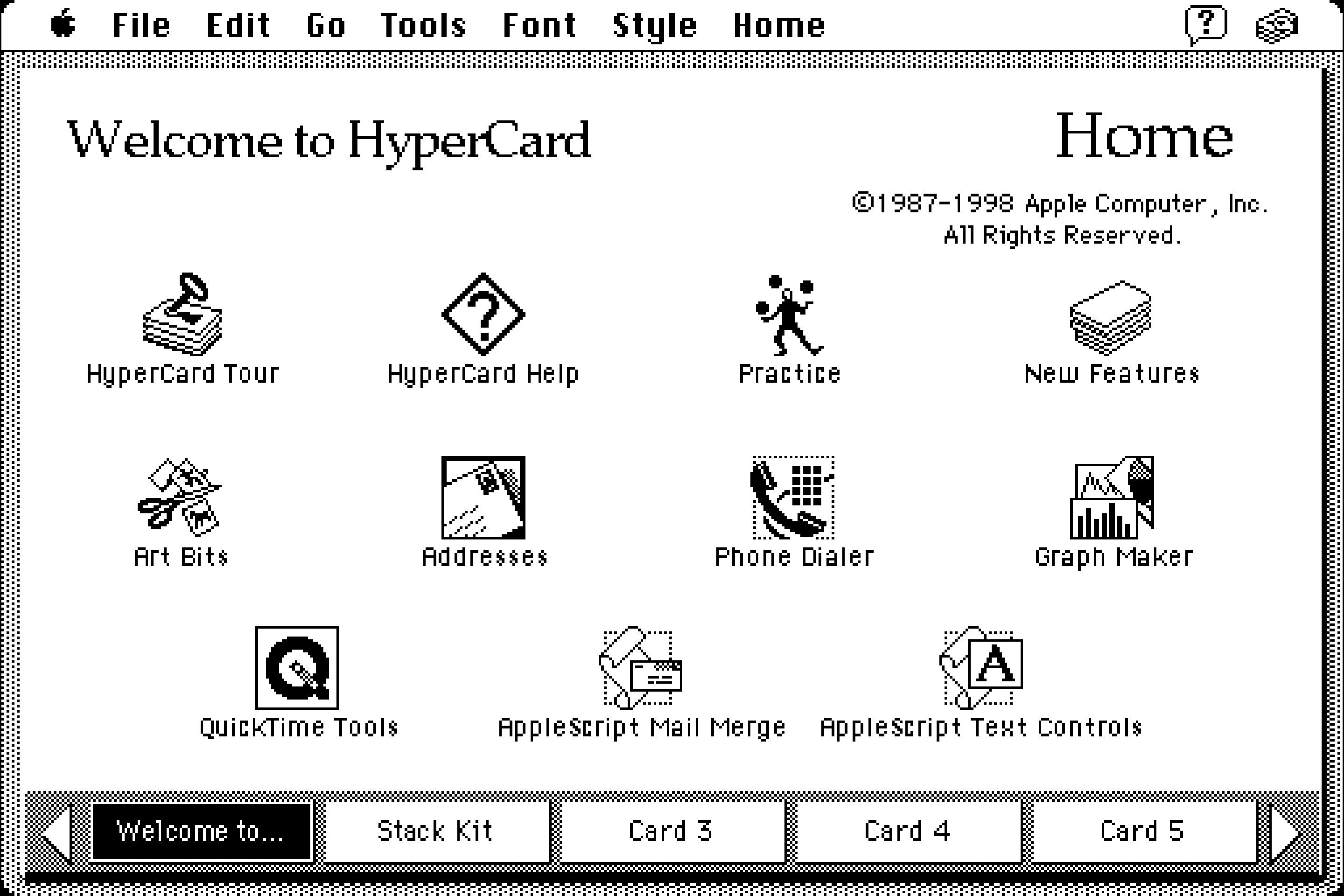
Apple HyperCard
Hypermedia system
Help humankind
share knowledge
Allowed lots of people to create small apps
What does a PL researcher see?
This is a 90-minute talk!
What can a programming languages researcher say about HyperCard?
Demo
HyperCard in action!
Interesting HyperCard facts

Unprecedented usability
- Same environment for authoring & use
- Controlled via user levels
Stateful interactive system
- Scripts live inside the stateful app
- Stacks are open to modification by default
No modern equivalent
- Hypermedia evolved into the Web
- What got lost in the process?
Programming systems
Different ways of looking
Programming systems
Different ways of looking
- Technical dimensions - heuristic analysis
- Complementary science - past systems
- Formal models - theory of systems
- User centric - talking to users
Technical dimensions
Qualitative systems analysis
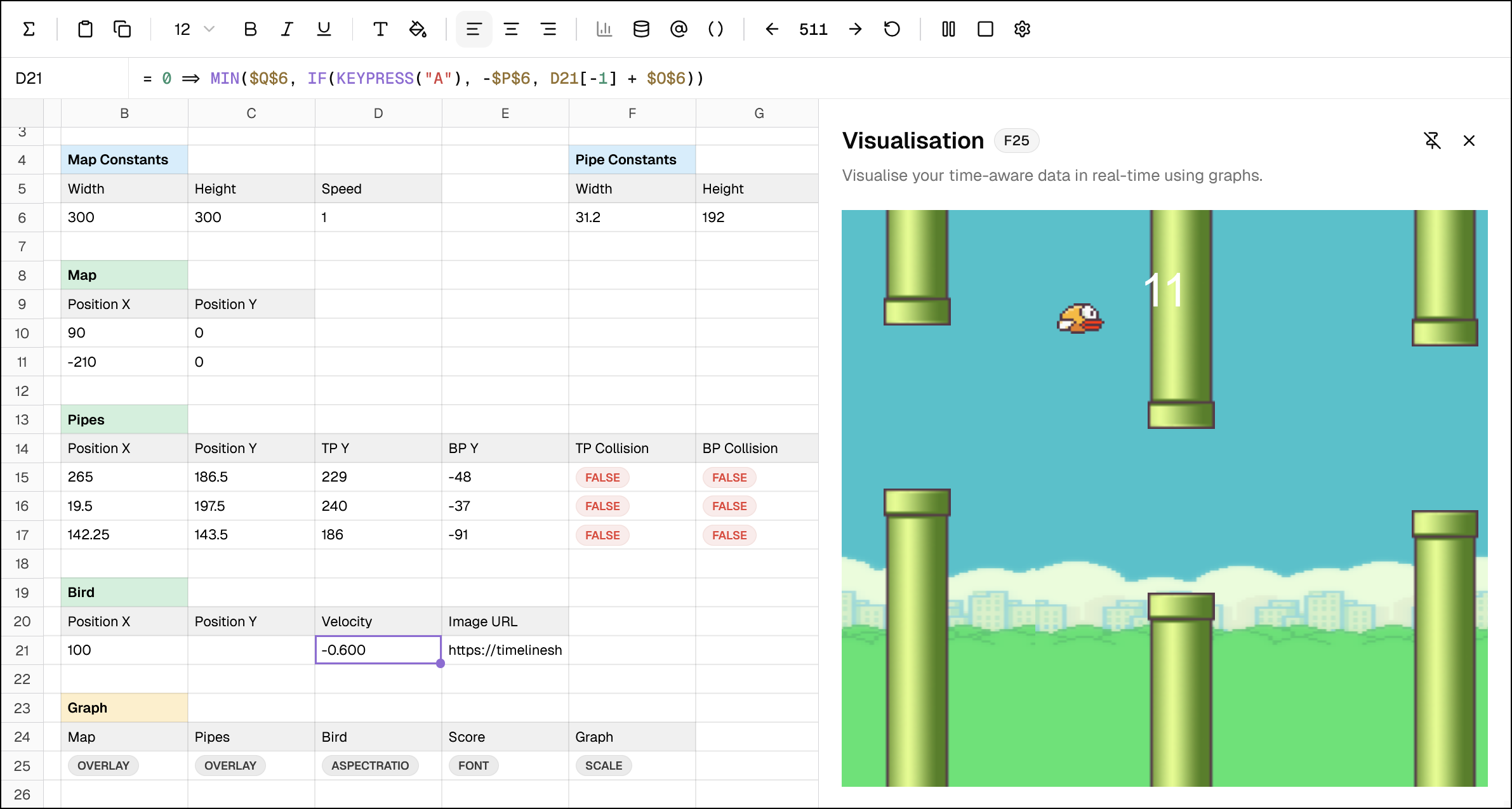
Timeline
Adding time to spreadsheets
Most widely used programming sys!
Keep simplicity & add expressivity
Comparison with using Python?
Experiment with Timeline!

Go to: https://timelinesheets.com
Or try: https://tinyurl.com/ecoop26-bird
Create simple time-aware calculations
A1 = 0 => A1[-1] + 1
B1 = 0 => B1[-1] + RAND(1) - 0.5
Audience participation :-)
How does spreadsheet system
(with time) compare to Python?
Technical dimensions
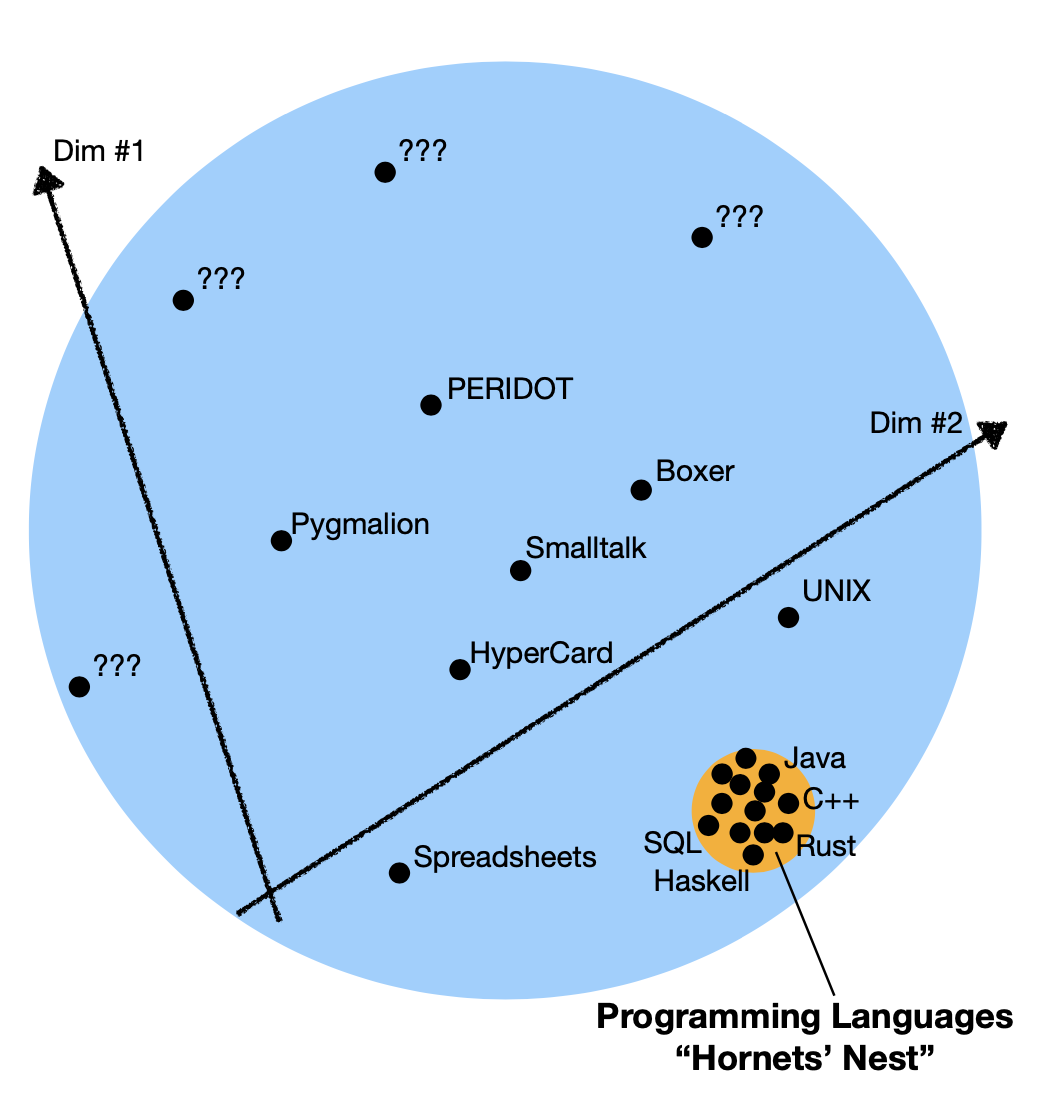
What is a dimension
- Captures a property of a system
- Covers old and new systems
- Defines a range of values
Using the framework
- Identify gaps in design space
- Characterise new and old systems
- Qualitative comparison of systems
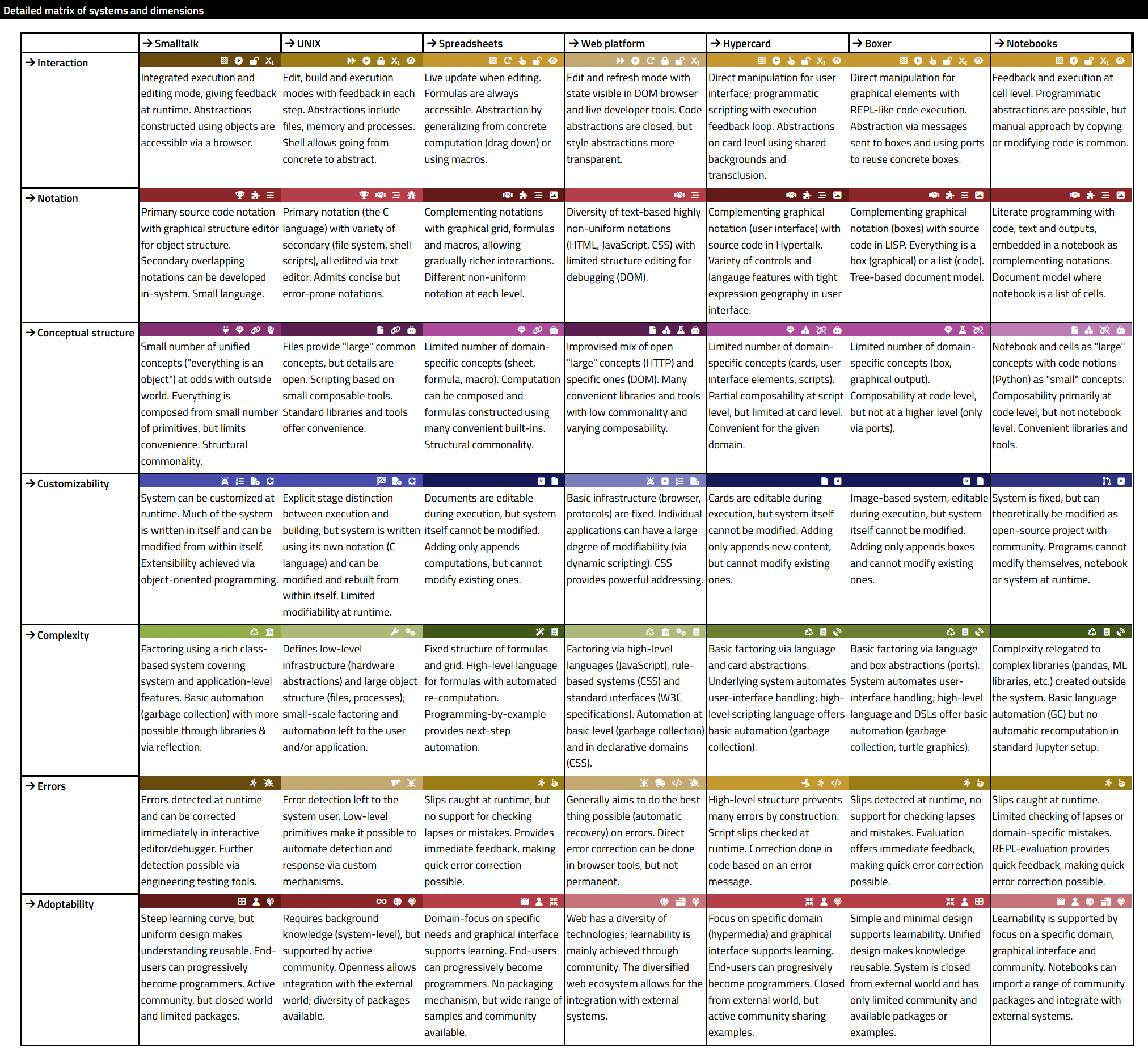
Catalogue
Analysed systems
LISP machines, UNIX, Web, Hypercard, Spreadsheets, Haskell, Boxer, DarkLang, etc.
Analysis of HyperCard
Modes of interaction
Programming happens in the
same interface mode as using
Primary & secondary notation
Graphics and basic interactions constructed graphically; script is secondary
Self-sustainability
Clear separation between app itself and
user code; cannot be modified from within
Analysis of Timeline
Analysis of Timeline
Modes of interaction
Programming happens in the
same interface mode as using
Abstraction construction
Code reuse by creating formula and using "drag down"
Composability vs. convenience
Timeline has composable charting primitives
but no built-in high-level charts
Complementary science
Learning from the past
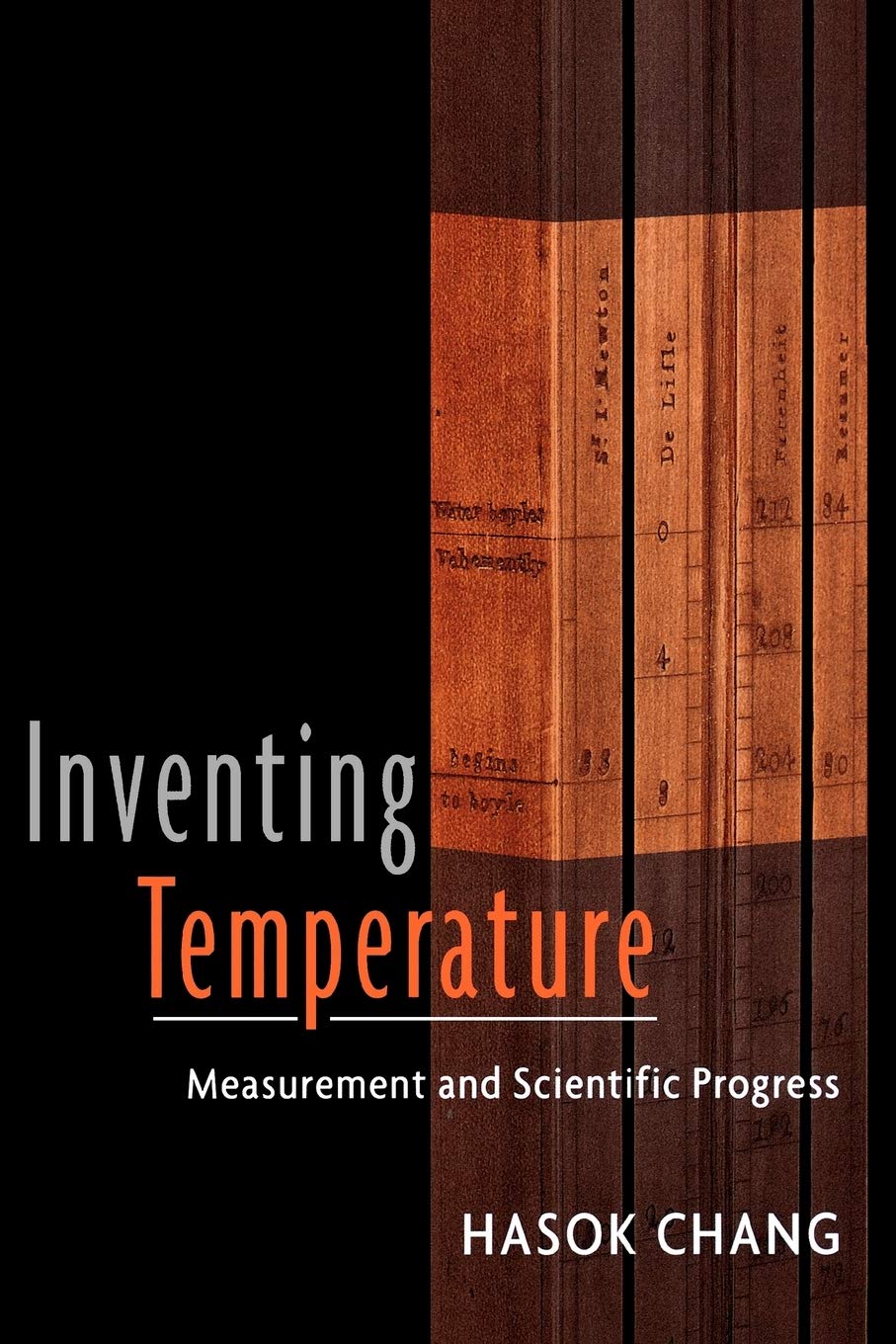
Complementary science
Scientific ideas get lost due to paradigm shifts
There is often something valuable lost too.
Do serious historical research to recover them!
Even more the case
in programming!
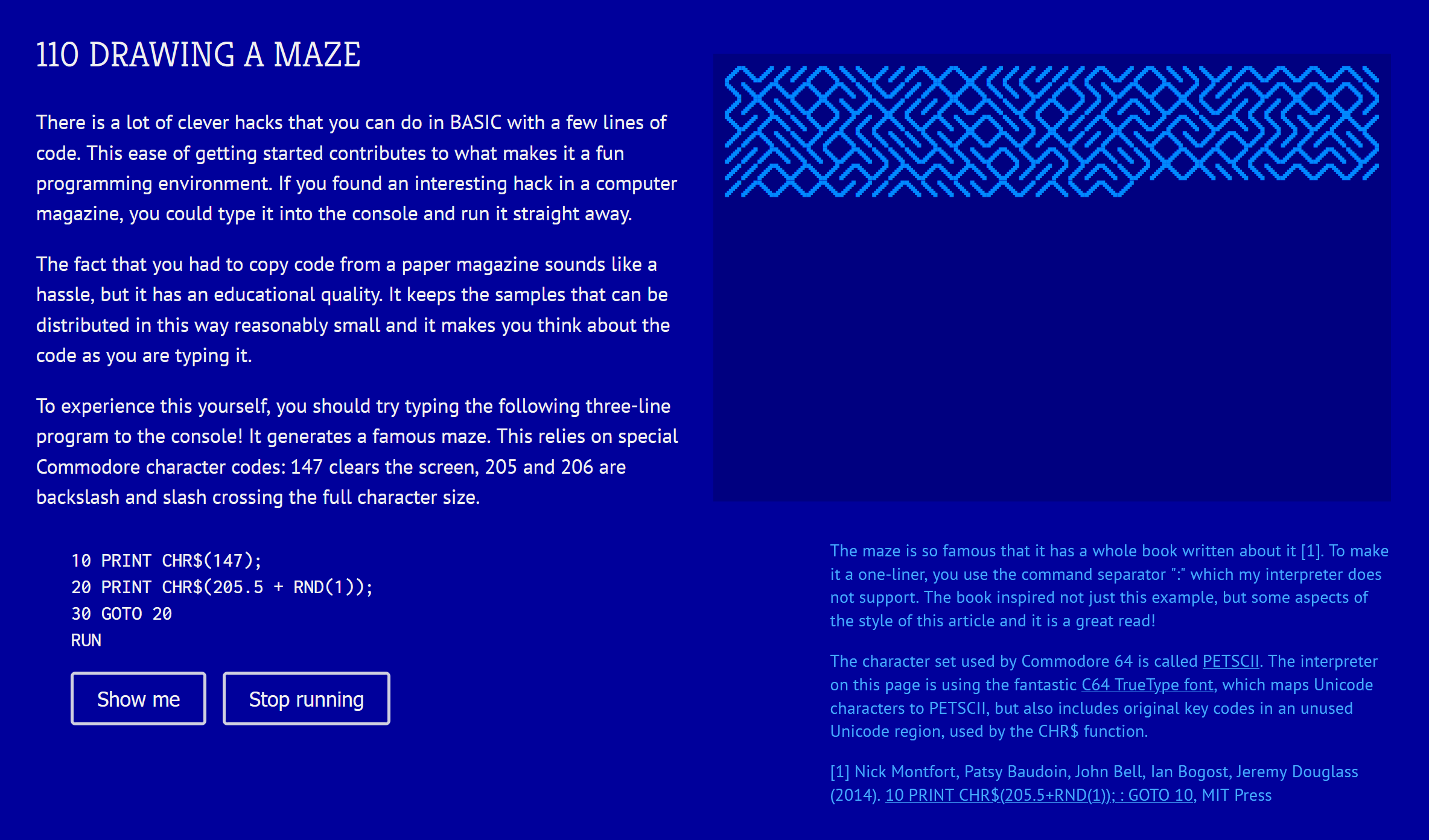
Commodore 64
"It is impossible to teach good programming to students that have had a prior exposure to BASIC" (Dijkstra)
What can we learn from BASIC?
Experiment with C64 BASIC!
https://tomasp.net/commodore64
Try printing Hello world!
PRINT "HELLO WORLD"
Try writing an infinite loop!
10 PRINT "HELLO WORLD"
20 GOTO 10
Audience participation :-)
Is there anything good about prefixing each
line with a number? What is the point?
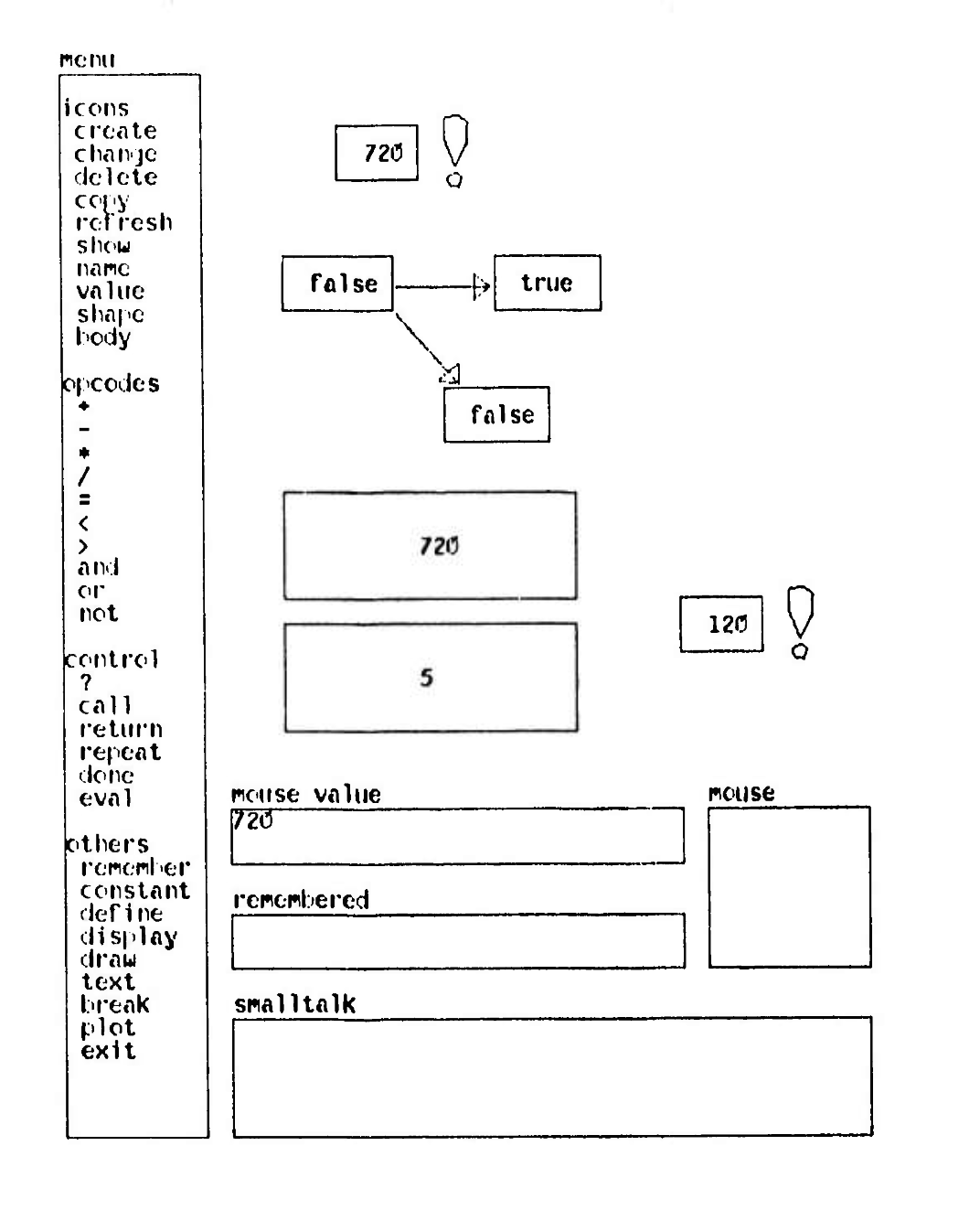
Pygmalion
Visual programming system based on demonstration
Largest Smalltalk 74 program ever written
What does using Pygmalion feel like?
Learning from Pygmalion
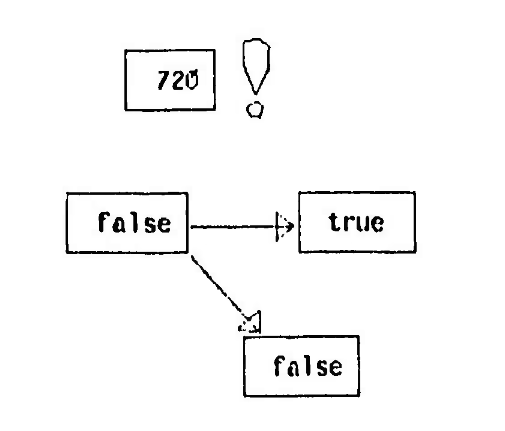
Abstraction construction
- From concrete manipulation
- Programming by demonstration
Visual programming
- Good iconic representations?
- Difficult in an abstract domain!
Learning from Commodore 64 BASIC
Learning from Commodore 64 BASIC

Modes of interaction
Terminal works as both REPL
and structure code editor
Factoring of complexity
Simple but experts can use POKE and SYS
Learnability
Simple unstructured language
Demos distributed as source in magazines
Formal models
Modelling interactive systems
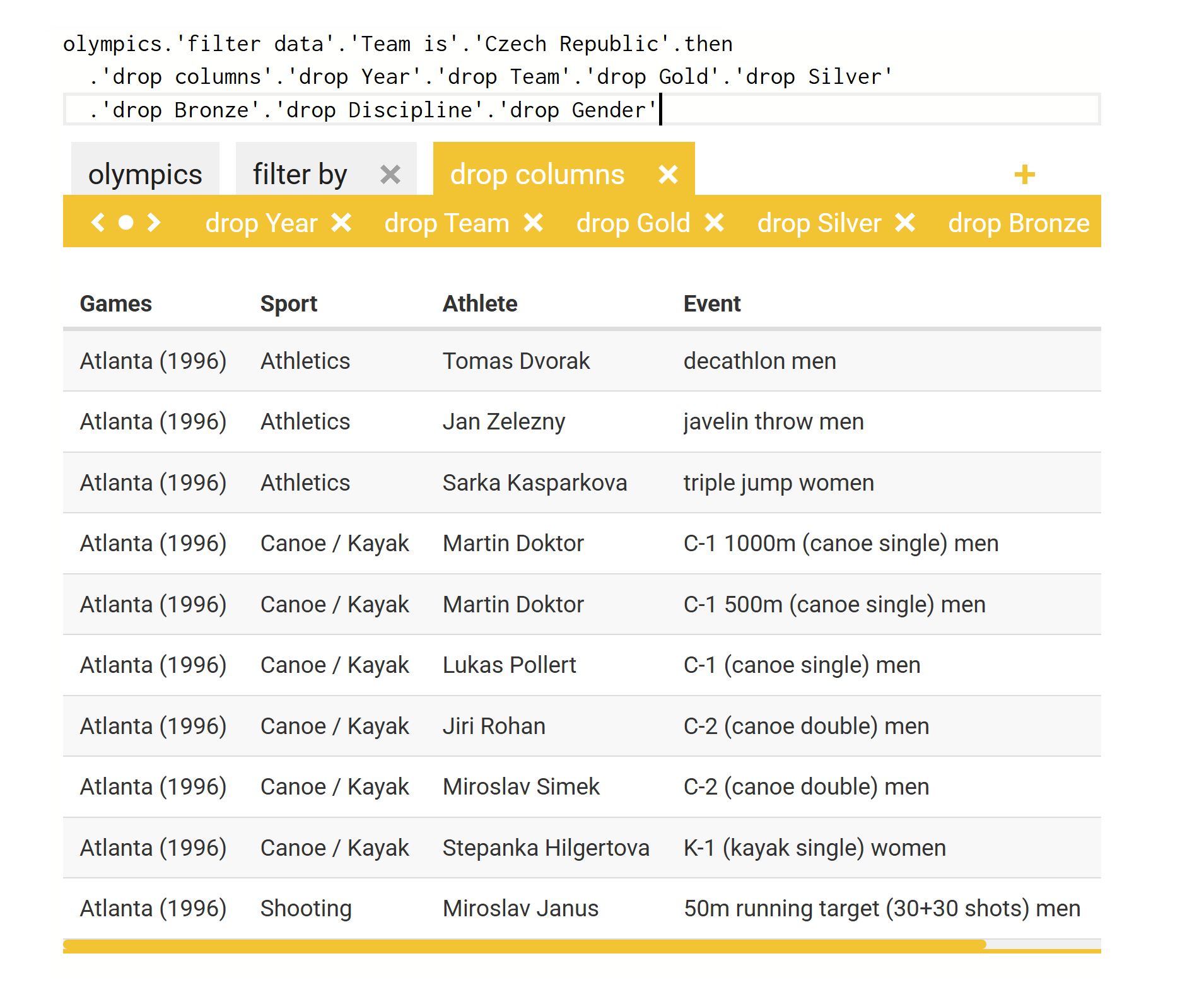
The Gamma
Programming for non-programmers
Explore data by repeatedly choosing from a list of offered options
What is the underlying language?
Explore Olympic medals in The Gamma!
https://thegamma.net or directly
https://tinyurl.com/ecoop26-olympics
Known issues in Firefox (sorry)
Old and buggy data (also sorry)
Type olympics. and choose an operation. Get top medalists or top teams?
Audience participation :-)
What is the model of The Gamma language
or system? Is there a formal grammar?
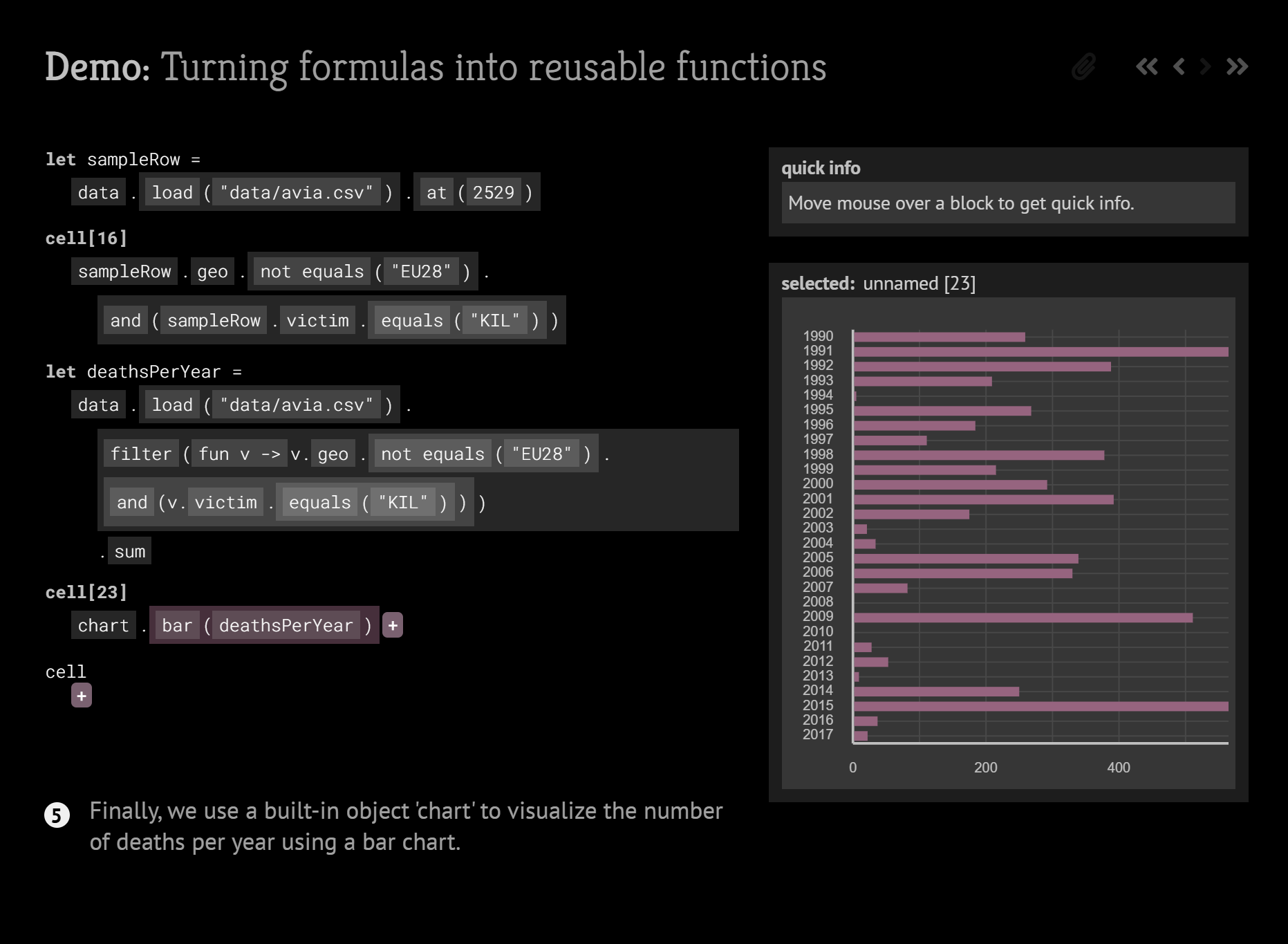
Histogram
Programs as lists of interactions
Keep track of the process!
Running code, refactoring
Formal models of programming systems
Formal models of programming systems
Grammar of The Gamma language
Program is a sequence of let bindings or invocations
Lambda only used as method parameter!
\[\newcommand{\lsep}{\;\;|\;\;} \newcommand{\kvd}[1]{\textbf{#1}} \newcommand{\narrow}[1]{\hspace{-0.6em}#1\hspace{-0.6em}} \begin{array}{lcl} p &\narrow{::=}& c_1; \ldots; c_n\\ c &\narrow{::=}& \kvd{let}~x = t \lsep t\\ \end{array} \quad \begin{array}{lccl} t &\narrow{::=}& o &\hspace{-1em}\lsep x \lsep t.m(e, \ldots, e) \\ e &\narrow{::=}& t &\hspace{-1em}\lsep \lambda x\rightarrow e\\ \end{array}\]
Reflects how data science scripting works!
We can get a preview for any sub-expression
Formal models of programming systems
Programming as list of interactions
Record operations as performed by the user!
\[\newcommand{\narrow}[1]{\hspace{-0.6em}#1\hspace{-0.6em}} \begin{array}{rcl} p &\narrow{::=}& i_1, ~\ldots,~ i_k\\ r &\narrow{::=}& \textbf{named}~n~~|~~\textbf{indexed}~i\\ i &\narrow{::=}& \textbf{def}~\textit{value}\\ &\narrow{|}& \mathbf{name}~\textit{ref}~\textbf{a}~\textit{name}\\ &\narrow{|}& \textbf{dot}~\textit{name}~\textbf{on}~\textit{ref}\\ &\narrow{|}& \textbf{apply}~\textbf{args}~\textit{ref}_1, \ldots, \textit{ref}_n~\textbf{to}~\textit{ref}\\ &\narrow{|}& \mathbf{evaluate}~\textit{ref}\\ &\narrow{|}& \mathbf{abstract}~\textbf{from}~\textit{ref}_1, \ldots, \textit{ref}_k~\textbf{to}~\textit{ref} \end{array}\]
We can talk about interesting things!
Render program as code or spreadsheet
Refine type information after \(\textbf{evaluate}\) interaction
Methods & formats
Explaining interactive systems
Programming experiences
Collaboration
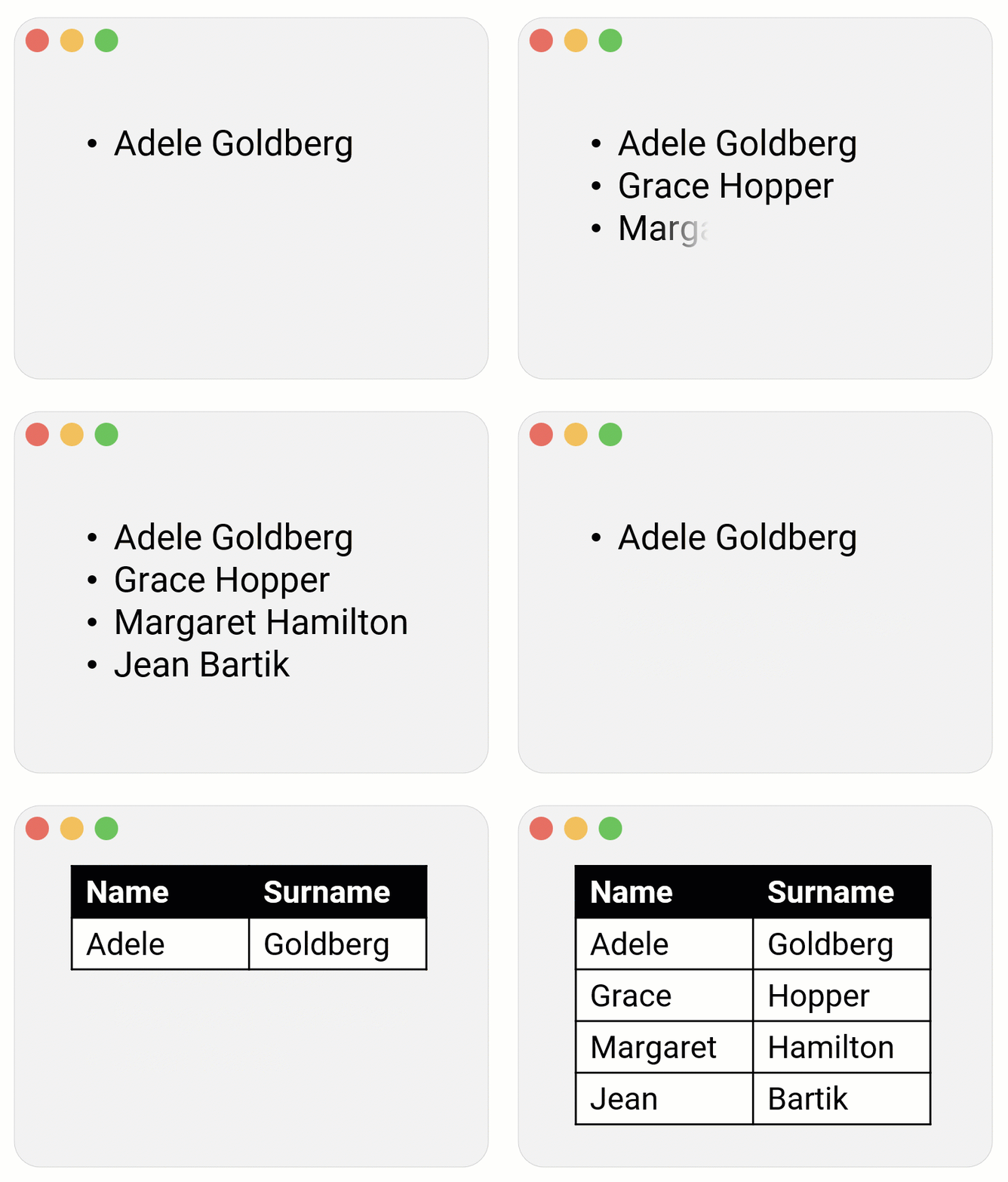
Merge edits made independently by different users
Demonstration
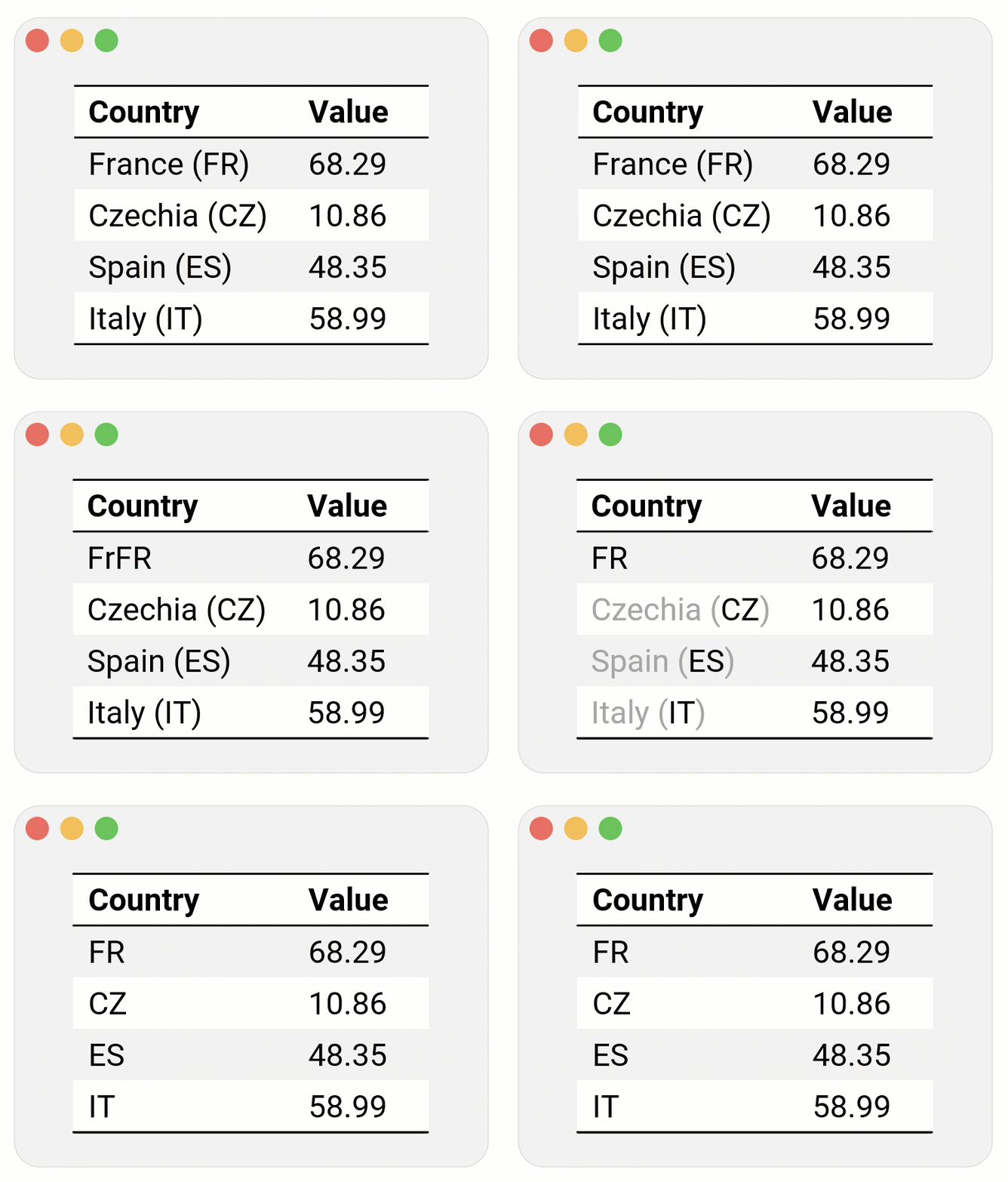
Specify program by showing concrete document action
Schema change
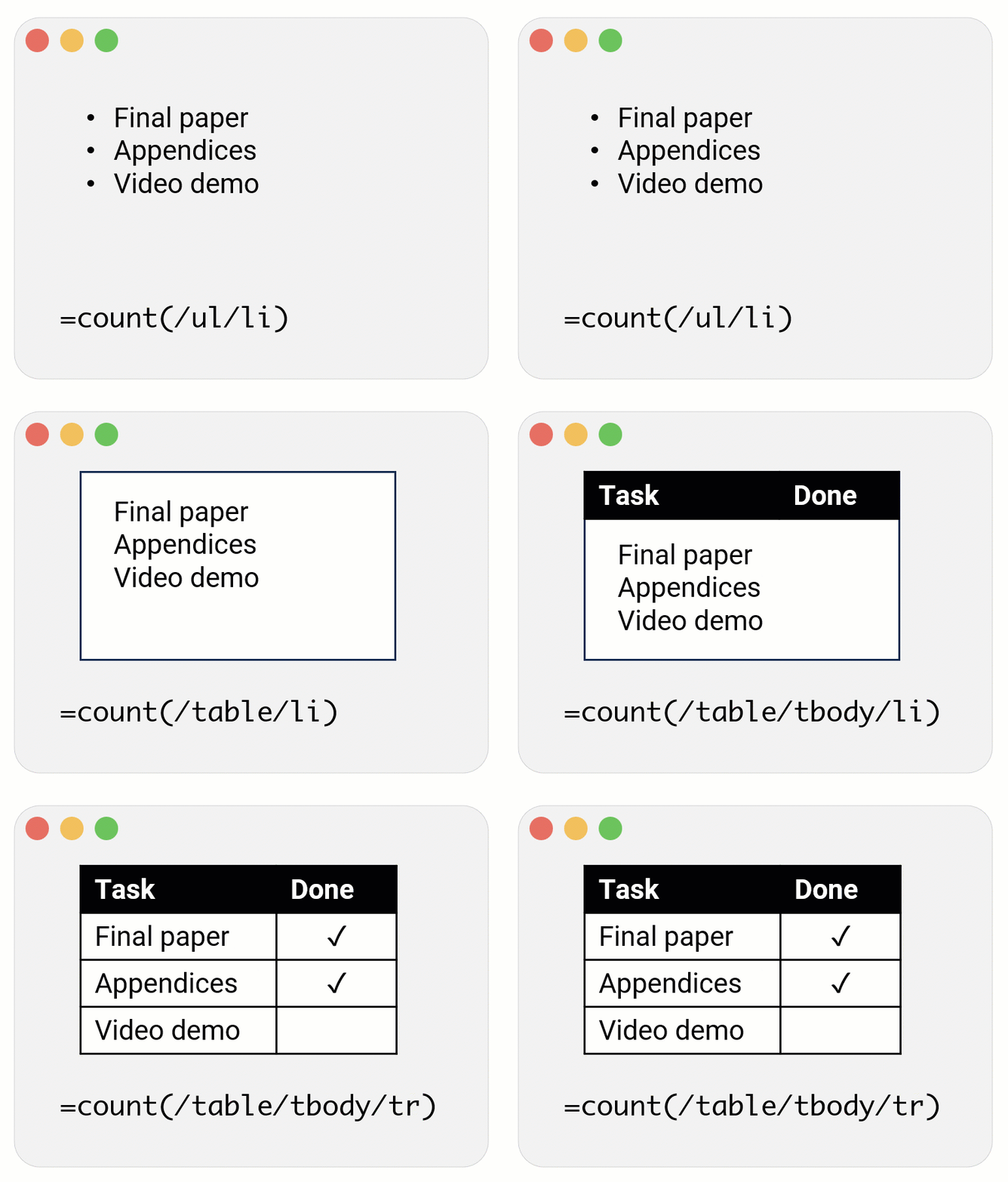
Adapt references when document structure changes
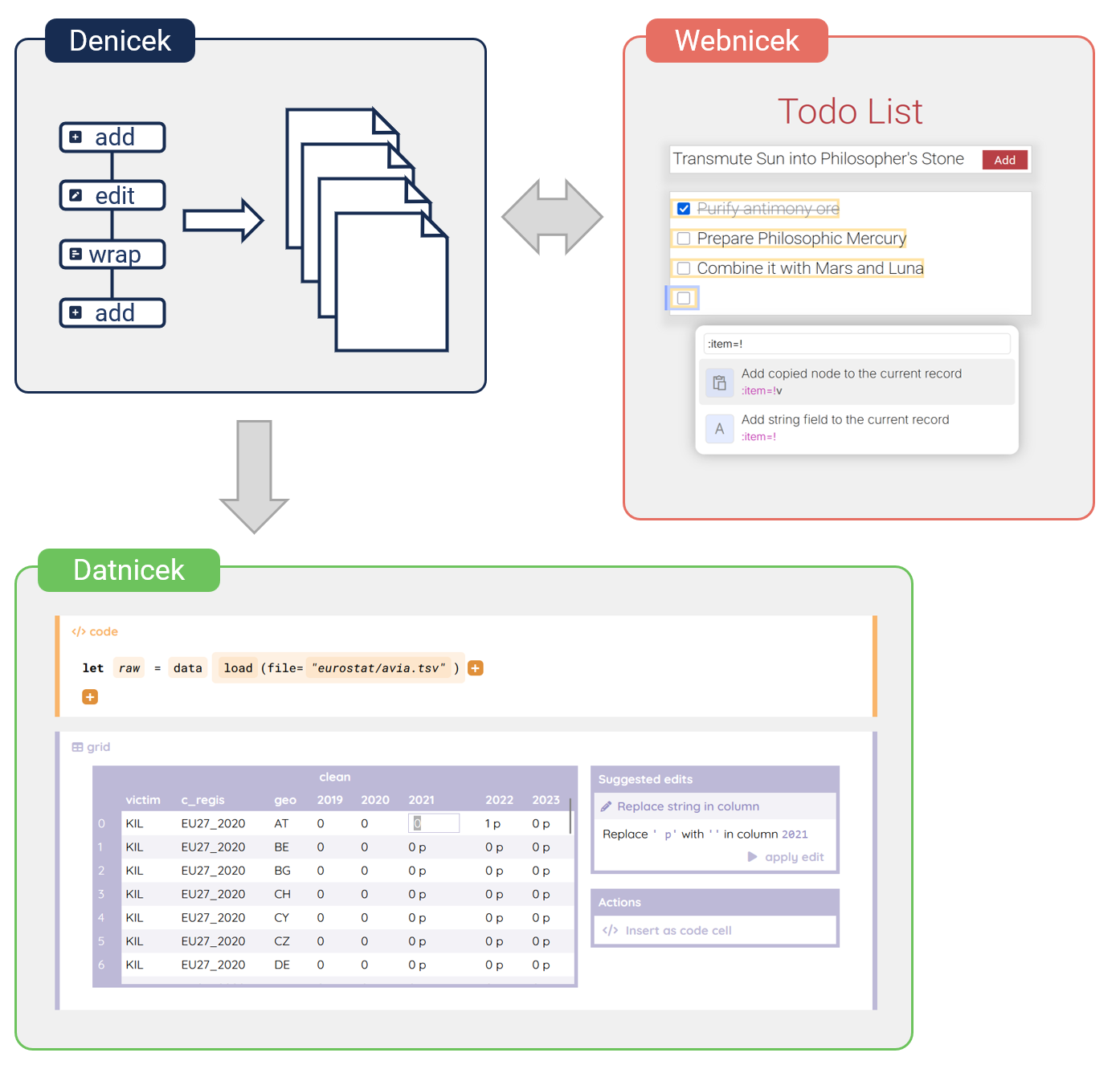
Denicek
Computational substrate for end-user document-oriented programming
Makes implementing
such systems easy!
Experiment with Denicek!
https://tinyurl.com/ecoop26-denicek
Replay the steps of Chapter 1 demo
Invoke @normalize! in step 4 yourself
Audience participation :-)
Compare an interactive essay with a classic paper!
Did you break it? Did you learn something extra?
Medium is the message
What do we choose to ignore?
-
Conventional academic papers
Ignore complexity, capture essence as formulas -
Video demos and webcasts
Show interaction, but what are the limits? -
Interactive essays
Guided walkthrough based on system prototype
Conclusions
Programming systems research
Research methods
-
Qualitative analysis
Mapping the design space of systems -
Formal models
Systems view breaks conventional wisdoms -
Human-computer interaction
How are systems used, how could they be used -
Complementary science
Learning from interesting past systems
Programming systems, or what
programming language research cannot see
Systems view opens new research questions
We can use many different research methods
AI agents interact with programming systems too
Tomas Petricek, Charles University, Prague