NPRG086: Functions, trees, processes
Monads in functional programming
Tomáš Petříček, 204 (2nd floor)
petricek@d3s.mff.cuni.cz
@tomasp.net
https://tomasp.net

Background
Thinking about monads
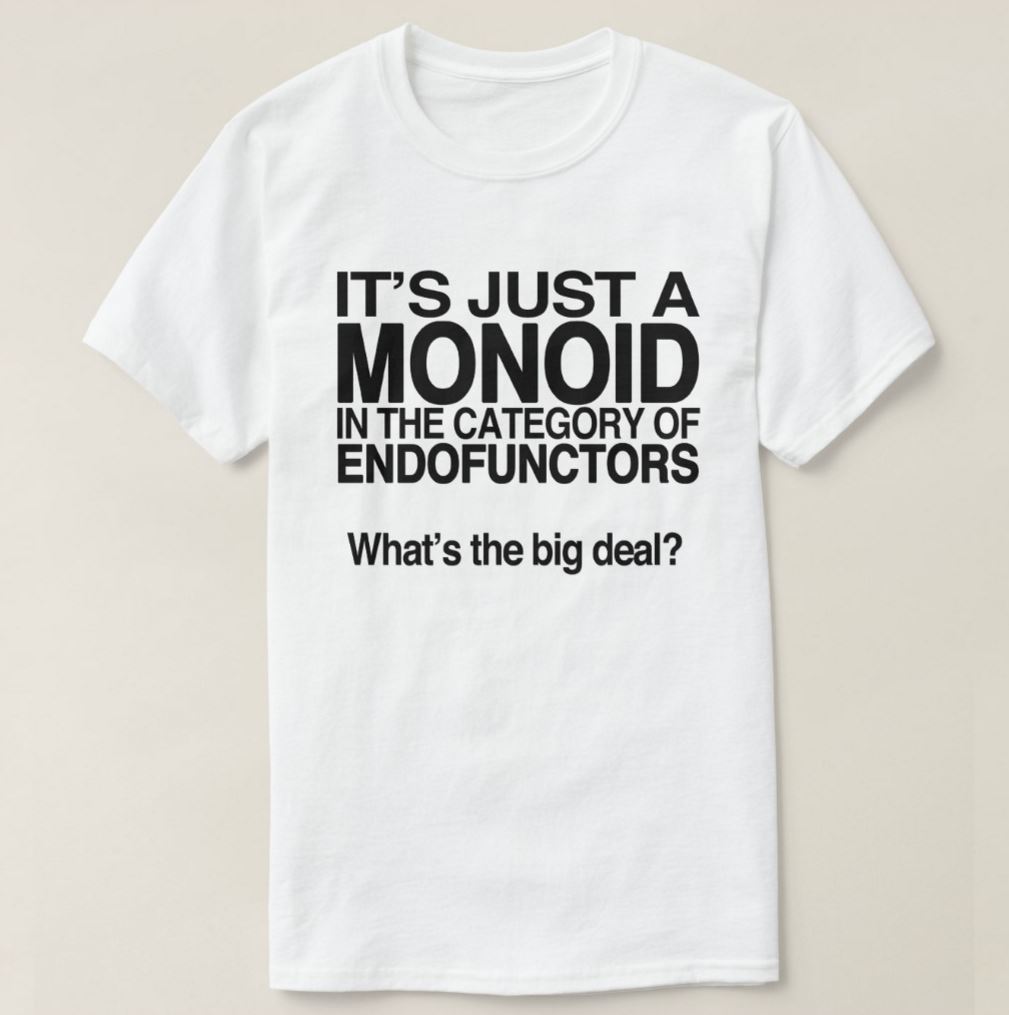
Monads in category theory
A monad over a category \(\mathcal{C}\) is a triple \((T, \eta, \mu)\)
where
\(T : \mathcal{C} \rightarrow \mathcal{C}~\) is a functor, \(\eta : {Id}_{\mathcal{C}} \rightarrow T\) and
\(\mu : T^2 \rightarrow T\) are natural transformations such that:
\[\begin{array}{l} \mu_{A} \circ T \mu_A = \mu_{A} \circ \mu_{T A} \\ \mu_{A} \circ \eta_{T A} = \mathit{id}_{T A} = \mu_{A} \circ T \eta_{A} \end{array}\]
\[\definecolor{mc}{RGB}{137,64,96} \newcommand{\mbnd}{>\!\hspace{-0.25em}>\!\hspace{-0.27em}=}\]
Monads in programming
A monad is a triple \((M, \mathit{unit}, \mbnd)\) consisting of a type
constructor \(M\) and two operations of the following types:
\[\begin{array}{lcl} \mbnd &::& M x \rightarrow (x\rightarrow M y) \rightarrow M y\\ \mathit{unit} &::& x\rightarrow M x\\ \end{array}\]
These operations must satisfy the following laws:
\[\begin{array}{l} \mathit{unit}~a~\mbnd~f ~=~ f a\\ m~\mbnd~\mathit{unit} ~=~ m\\ (m~\mbnd~f)~\mbnd~g ~=~ m~\mbnd~(\lambda x.f x~\mbnd~g) \end{array}\]
Metaphors
Explaining monads
Monads as a formal entity
Monad is a data type
Data type M a with operations (satisfying monad laws)
Operation return has a type a -> M a
Operation >>= has a type (a -> M b) -> (M a -> M b)
Many examples of monads
List a- list of zero or moreavaluesMaybe a- eitherJust aorNothingReader aandState afor managing state...
Monads as containers
Monad is like a box of things




Monads as computations
Monad is like a railway track
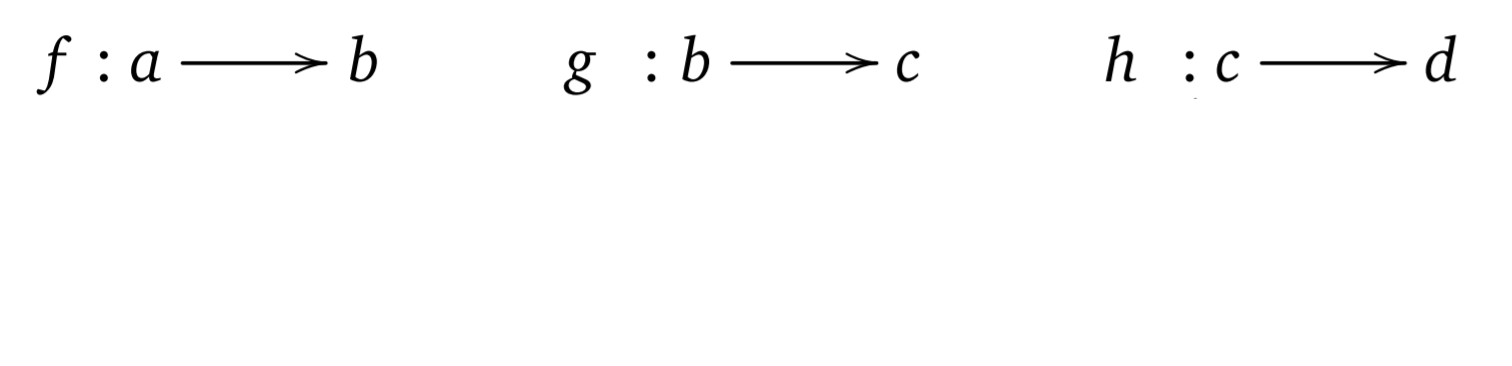
Monads as computations
Monad is like a railway track
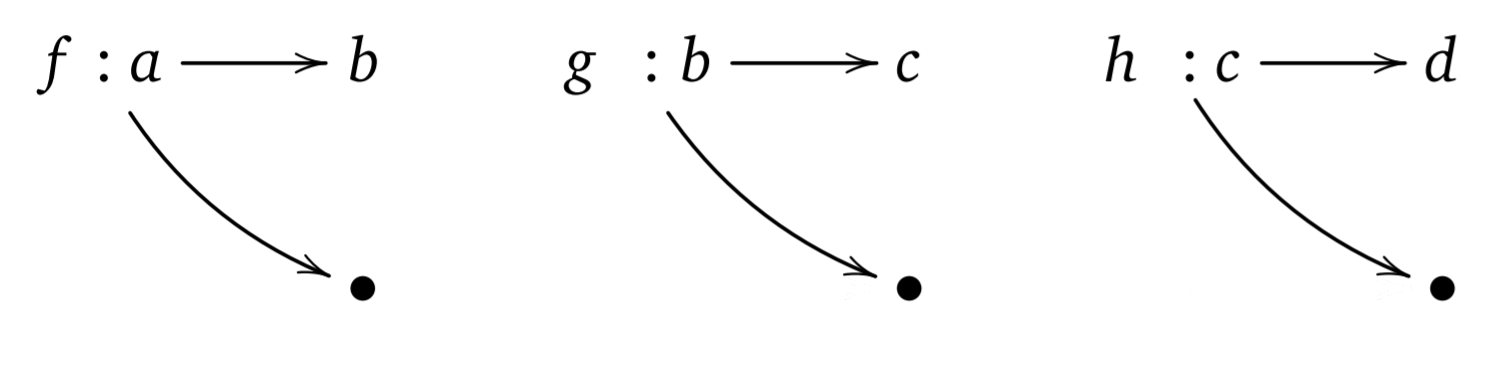
Monads as computations
Monad is like a railway track
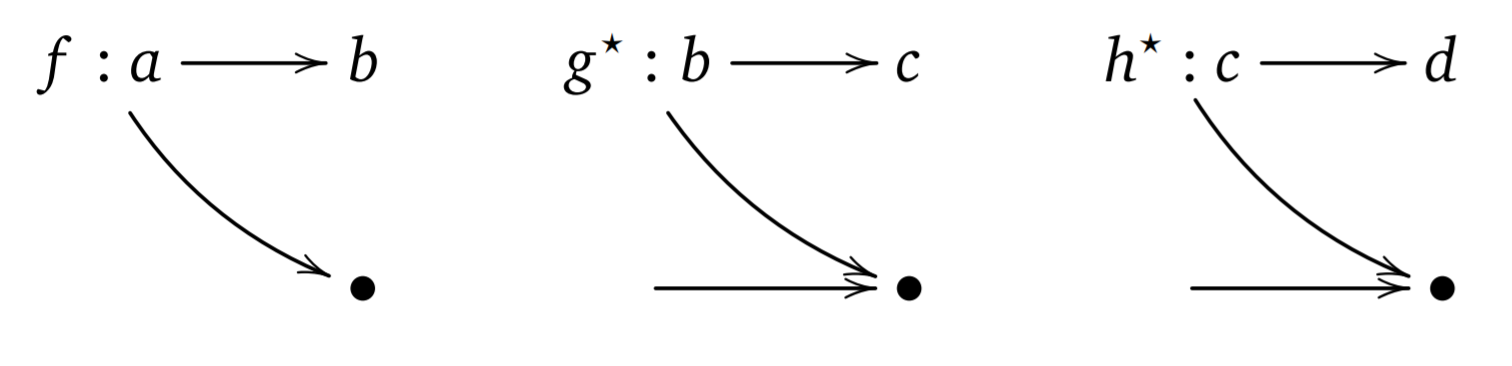
Monads as computations
Monad is like a railway track
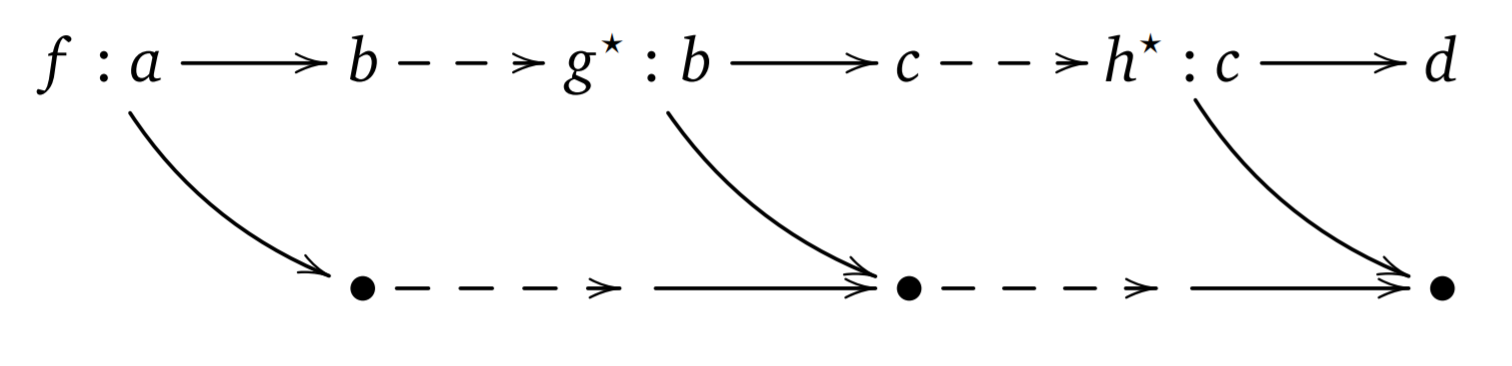
Metaphors
Thinking about monads
- Cognitive view of maths (Lakoff & Núñez)
- Movement when composing computations
- Inside/outside when using containers
- Metaphors criticised as too concrete!
- Symbol pushing also a metaphor...
Origins
Programming with monads (1985-95)
Functions
Problematic extra behaviour
- Partiality - function not defined / not terminating
- Exceptions - computations fail with no result
- Input/output - interaction with the environment
- Non-determinism - produce multiple results
- Parsers - detect patterns in input stream
Two struggles with extra behaviour
Formal semantics
- Formal model of real-world programming languages
- Deal with messy aspects of reality
Language design
- Unify handling of multiple aspects
- Encode extras in pure languages
-
Most can be encoded already,
but some cannot (input/output)
Case #1: Partiality
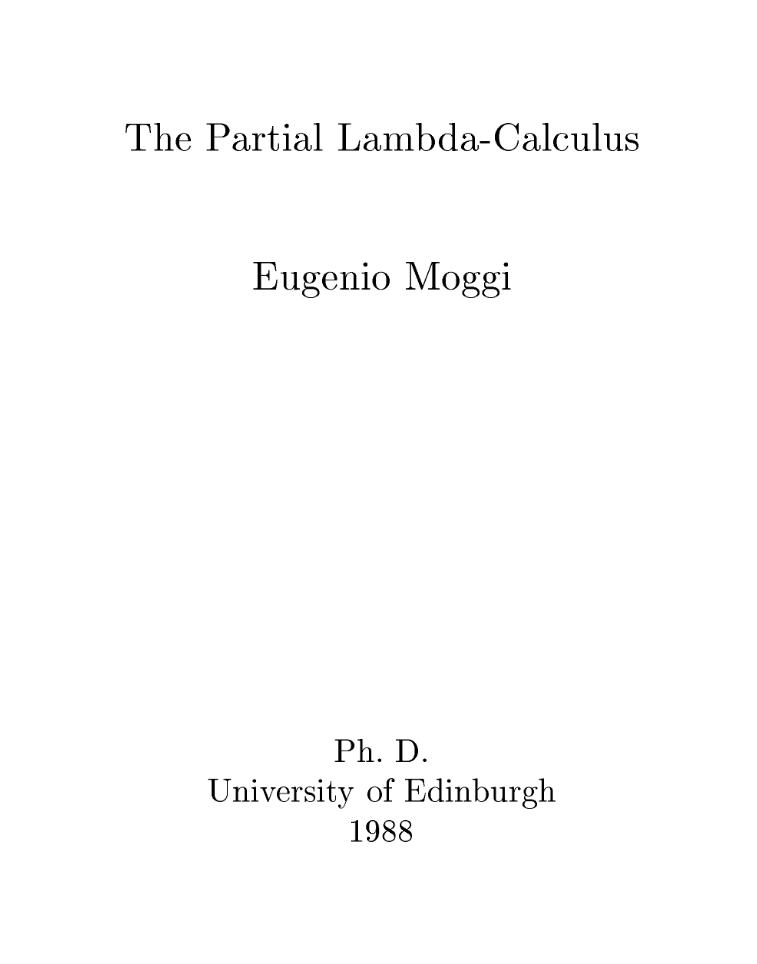
(Moggi, 1988)
Reasoning about partial functions that may fail or may not terminate
Defines category of
partial functions
Dana Scott's domain-theoretic models & LCF
Language semantics
Case #2: Lists of successes (Wadler, 1985)
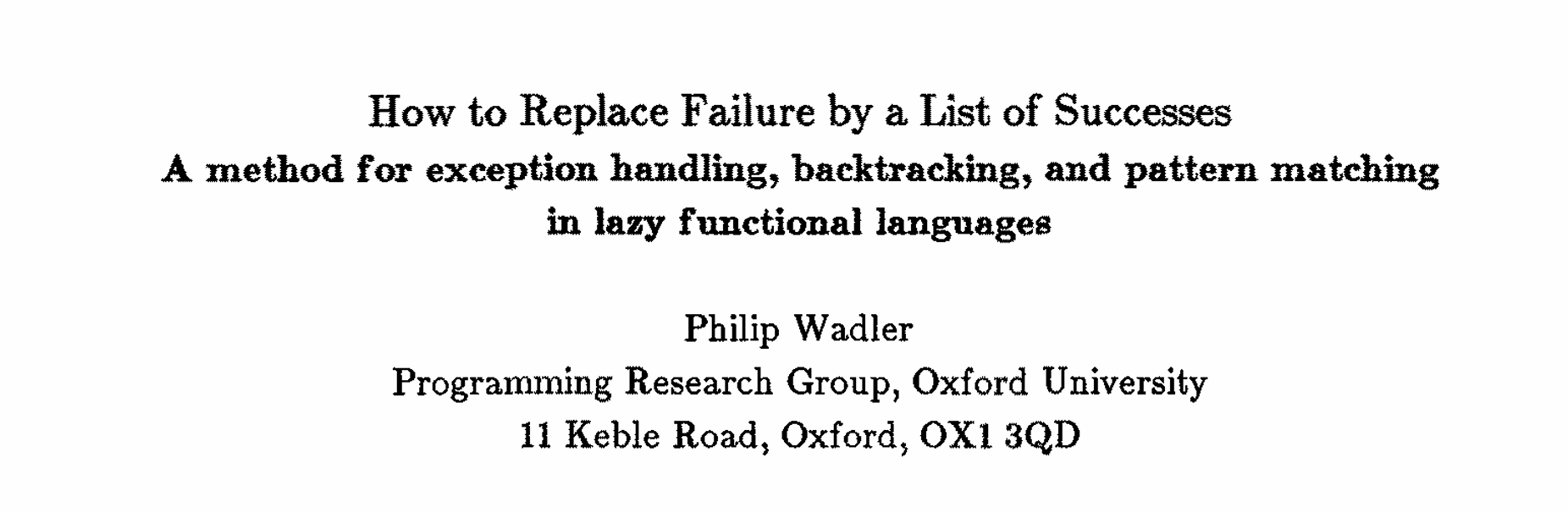
Model extras as lists
- Failures (one or zero)
- Backtracking (lazy lists)
- Parsing (list of matches)
List comprehensions notation
- Miranda's
[ a + b | a <- foo, b <- foo ] -
Translated to list-processing primitives
flatMap : a list -> (a -> b list) -> b list - Syntax works for many extras!
- Not recognized as monadic (yet)
Lists and exceptions (Spivey, 1989 & 1990)
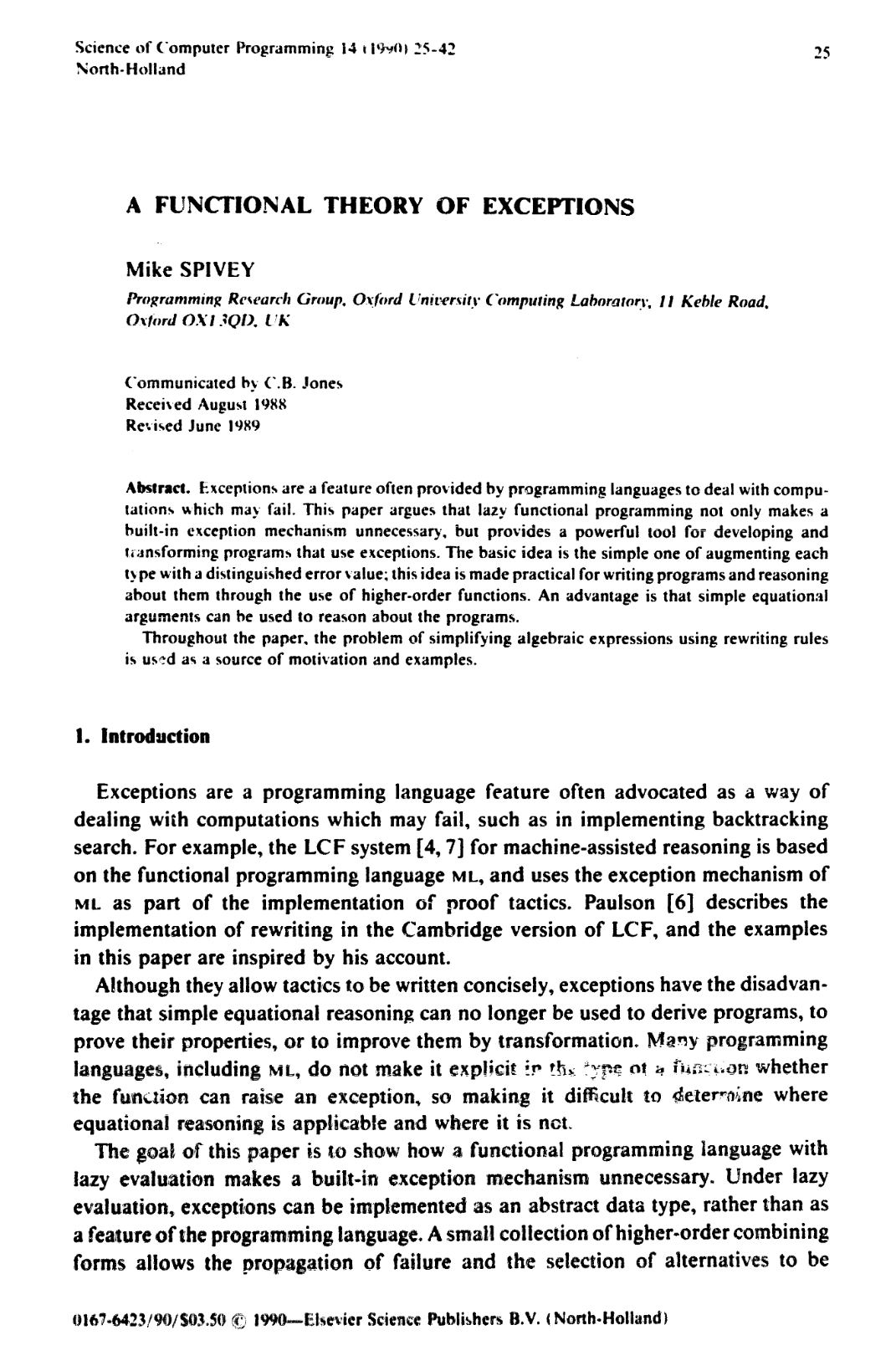
Theory of lists (1989)
- Categorical model of lists & expr trees
- "monads seem especially promising"
Theory of exceptions (1990)
- \(\bullet : (\alpha \rightarrow \beta) \rightarrow \textnormal{maybe}~\alpha \rightarrow \textnormal{maybe}~\beta\)
- \(prop : \textnormal{maybe}~(\textnormal{maybe}~\alpha) \rightarrow \textnormal{maybe}~\alpha\)
- \(succeed : \alpha \rightarrow \alpha\) [sic]
- Monad, forming category via Kleisli construction
- Derive laws of list comprehensions
Kent Applicative Operating System
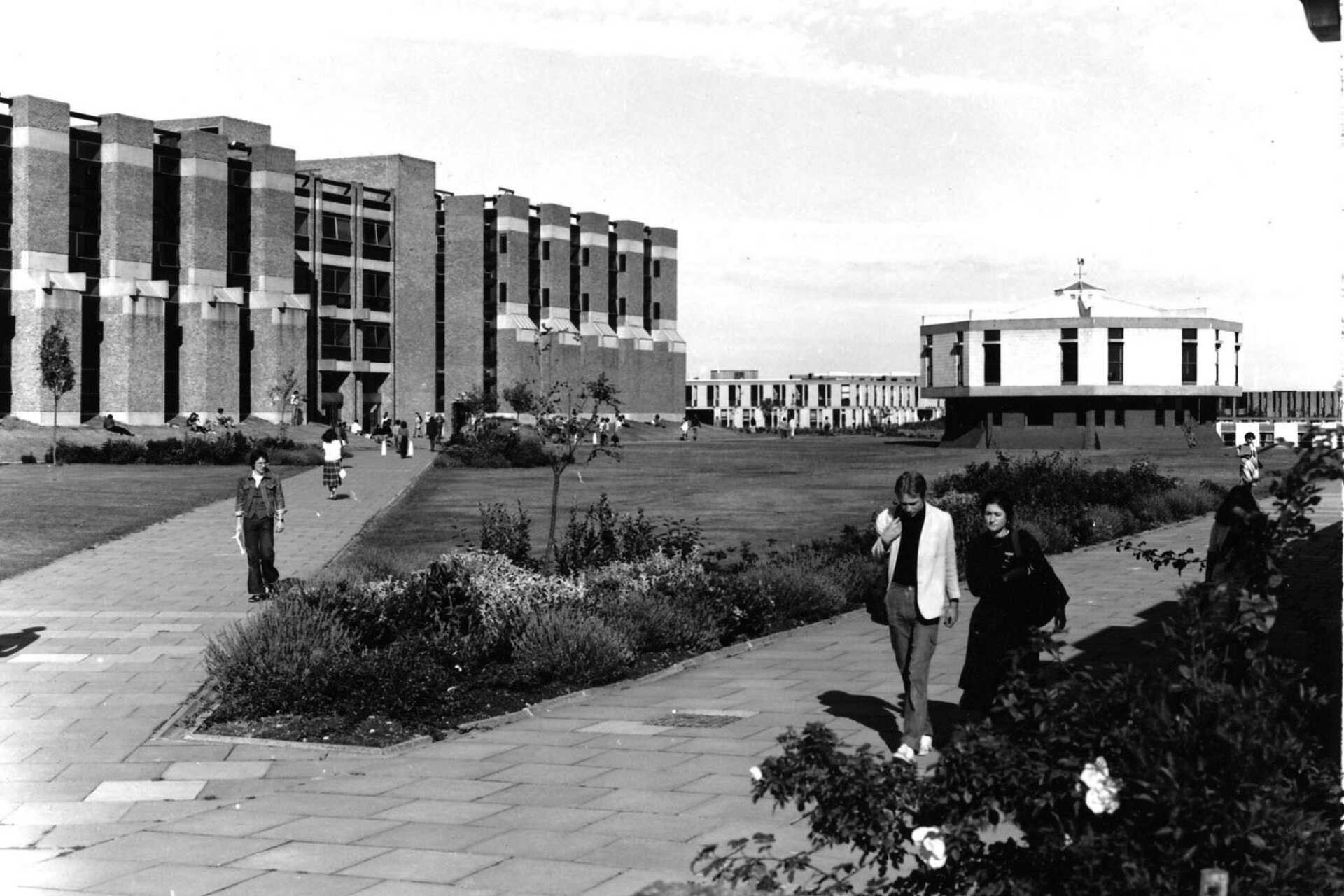
John Cupitt (Kent, 1988, 1989) 14,000 lines of Miranda code
Refined Simon Thompsons interaction combinators
return : a -> interact a
comp : (a -> interact b) -> (interact a -> interact b)
Based on stream-based input/output model (Landin, 1970s)
Dialogue = [Response] -> [Request] (Haskell 1.2, 1985)
Monadic operations but without reference!
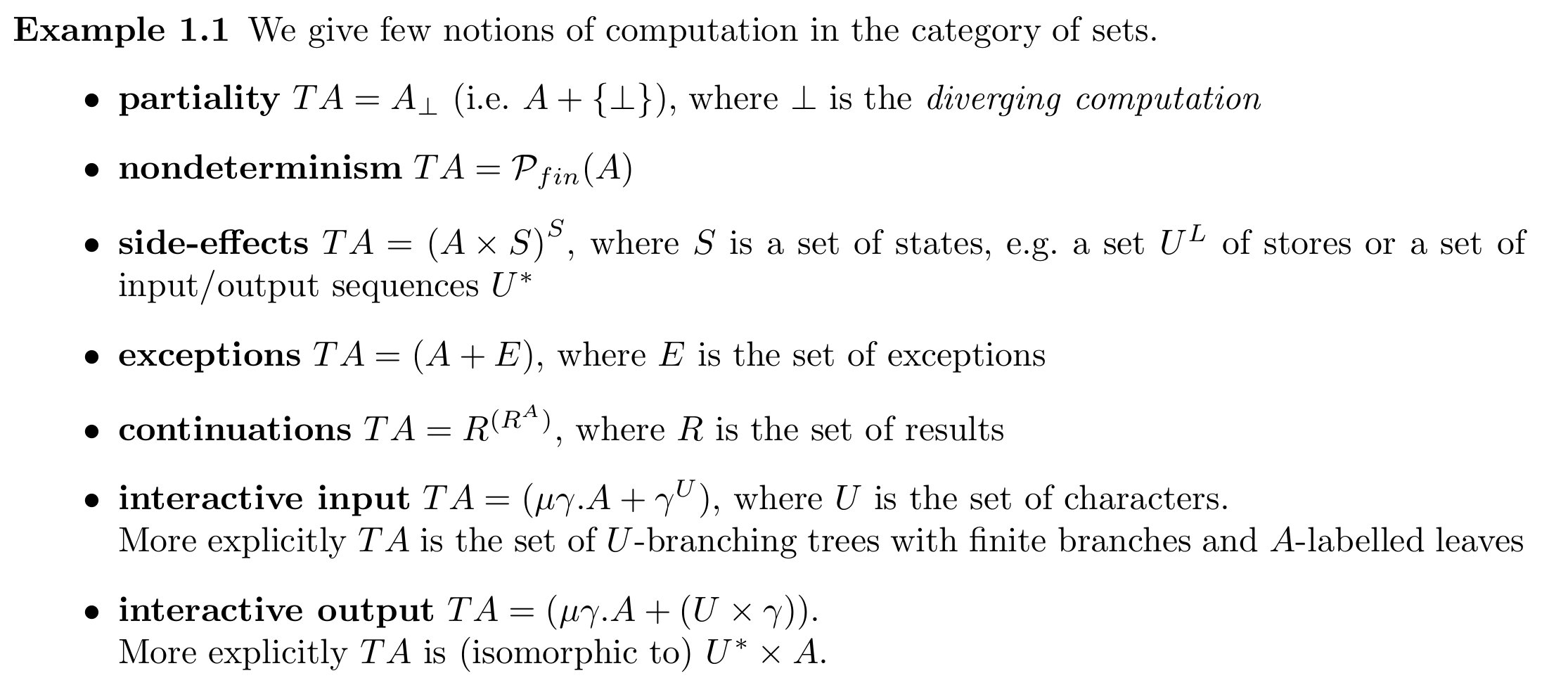
Notions of computation & monads (Moggi, 89-91)
Cites discussion with Martin Hyland at PhD defence
Categorical semantics of computation based on monads
Model
Supercooled liquid?
- List comprehensions syntax
- Two ways of expressing monads (bind/join)
- Links to monads in category theory
- Definitions of monads for common extras
- Oxford, Edinburgh, Kent, Glasgow
Comprehending monads
(Wadler, 1990-92)
Monads for design
Examples of monads from Moggi - strictness, parsers, state, exceptions, IO
From list comprehensions to monad comprehensions
Join or "container" model
Applications
Lazy functional IO
Changing world (Wadler, 1990)
An old canard against functional languages is that they cannot change the world:
They do not "naturally" cope with changes of state, such as altering a location in memory, changing a pixel on a display, or sensing when a key is pressed.
Earlier ways of handling IO
Stream-based models
[Response]->[Request]function- Recursion to manage state
- Use combinators to compose
- Haskell 1.2 original model
World-based models
- Take
Worldand return newWorld - Can be duplicated, used & discarded!
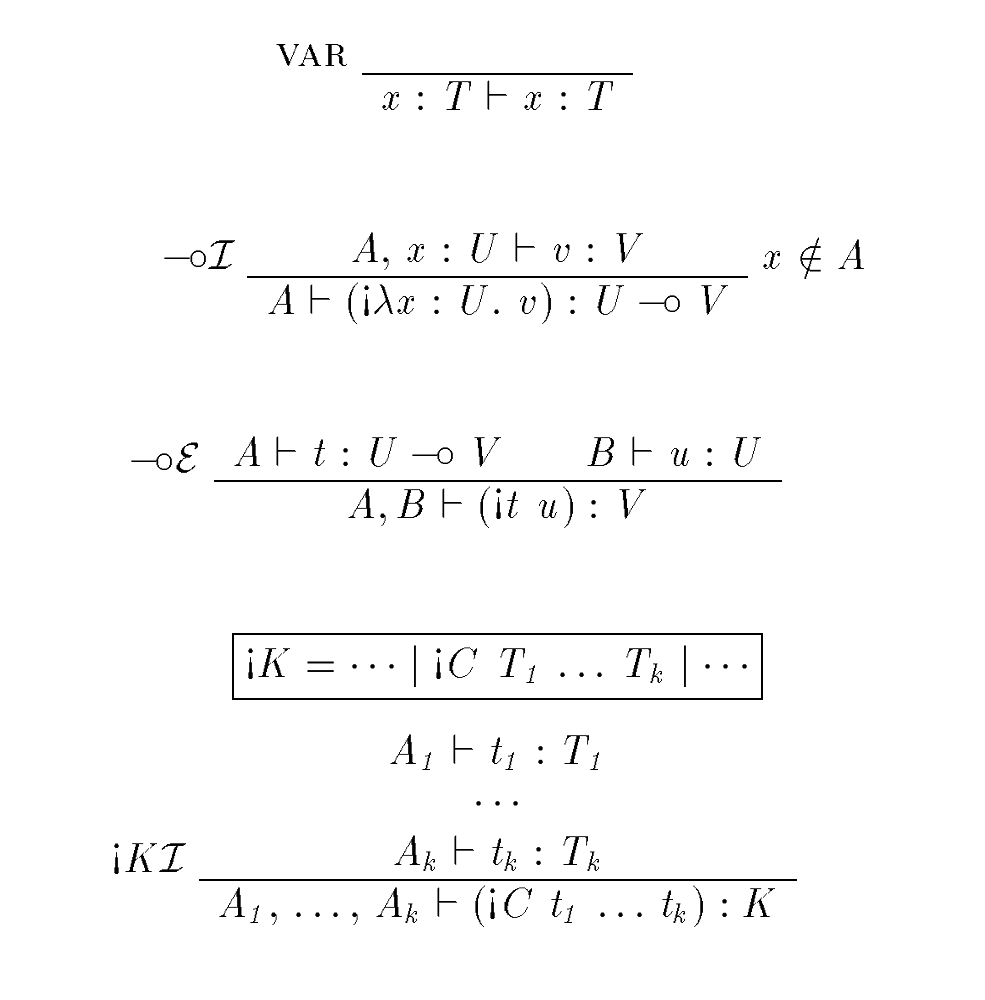
Linear types can change the world
(Wadler, 1990)
Two operations to rule out!
dup a = (a, a)kill a = ()
Type system based on ideas from linear logic
Lot to add to Haskell!
Imperative functional programming
(Peyton Jones & Wadler, 1993)
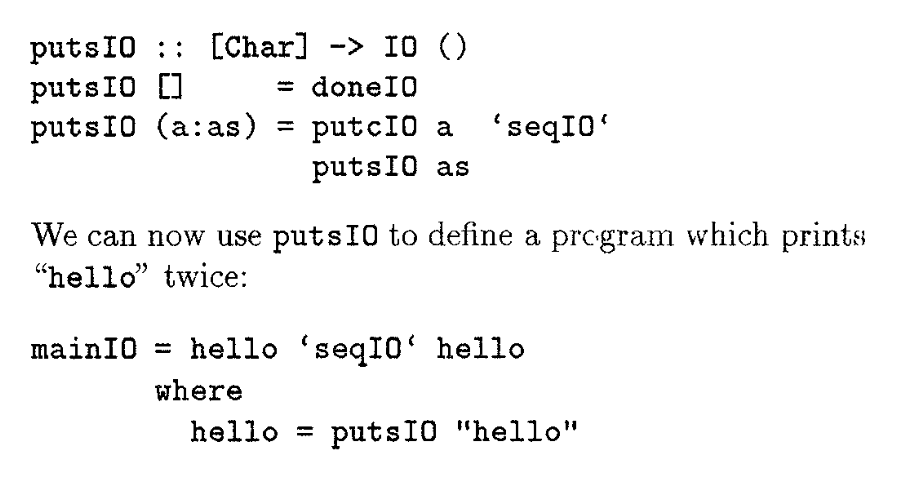
Works thanks to laziness!
- Type
IO afor effectful computations - Operation
seqIO : IO () -> IO a -> IO a
Monads
Handling input and output
- Linear types fit research programme!
- Sound theory, impractical for implementation
- Monads as an alternative practical solution
- Unclear what the IO monad denotes
- Criticisms - is it even a monad??
Not the essence
Metaphors and syntax
Essence of Functional Programming (Wadler, 1992)

Why have regrets about syntax?
Syntax is not the essence of the idea!
Becomes very useful and important in practice...
Not part of the research programme?
Two notations for monads
Comprehensions
Existed before for lists
Used to handle extras!
  [ a + b |
      a <- foo
      b <- bar ]
Generalized but dropped
Monad as container
Monad syntax
Introduced in IO context Launchbury's Gofer (1993)
{ a <- foo;
  b <- bar
  return (a + b) }
Added to Haskell in 96
Monad as computation
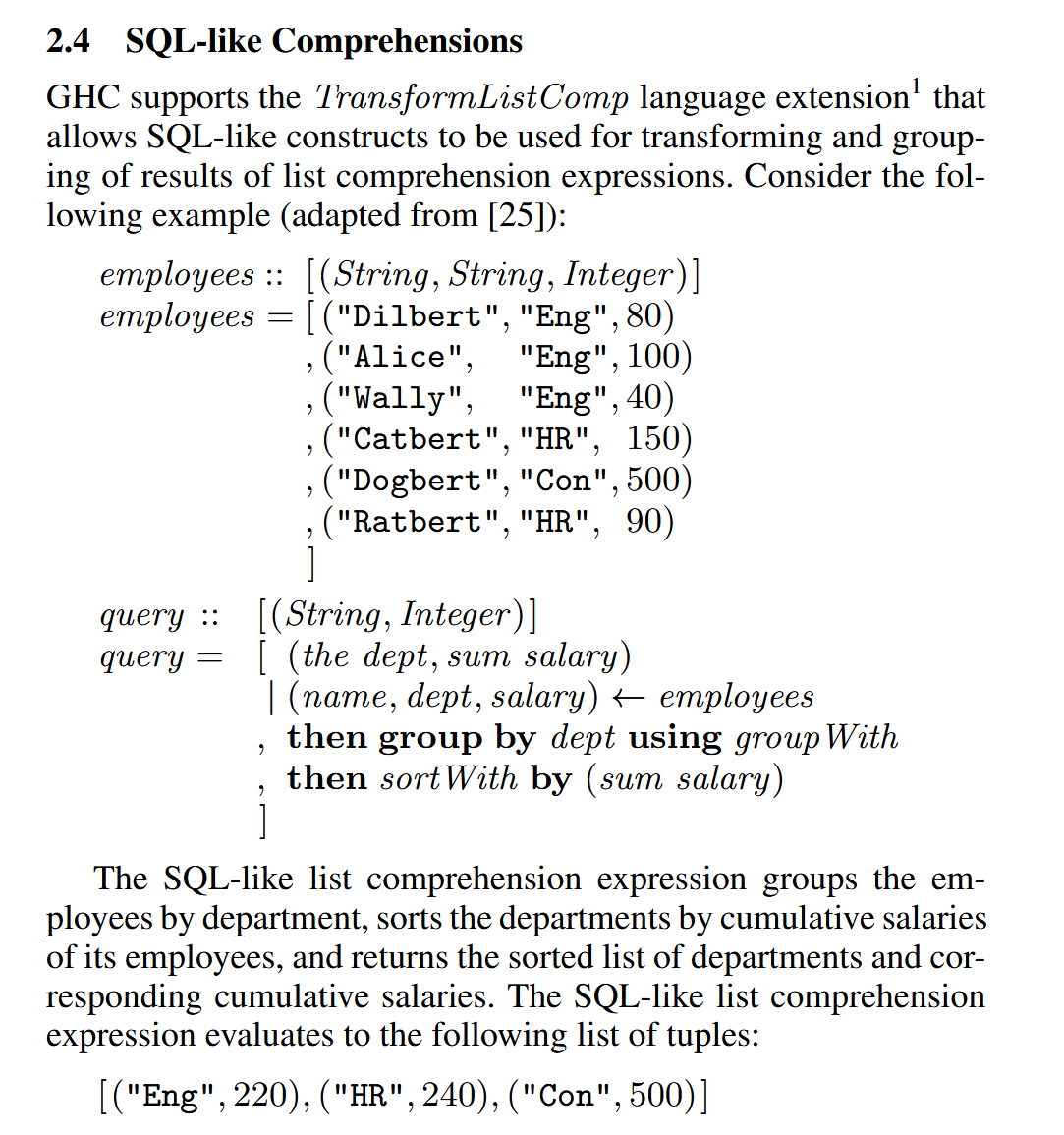
SQL comprehensions
Bringing back monad comprehensions
Requires additional operations: groupWith, filter, zipWith, etc.
Practical motivation, no categorical model!
The F# Computation Zoo
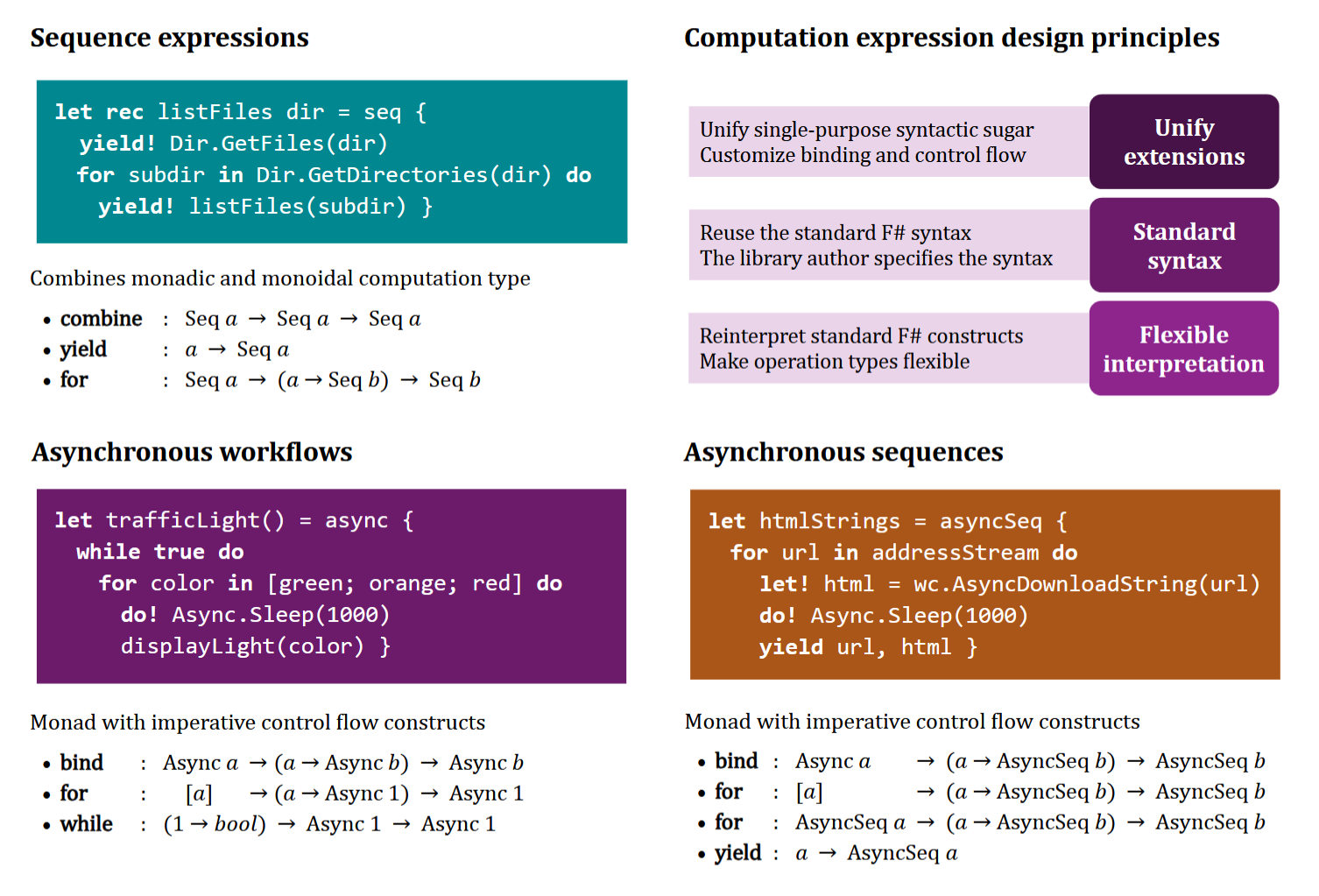
Monads
Comprehensions and do notation
- Essential part of the origins!
- Comprehensions for containers
- Do notation for computations
- Interesting research extensions
- Syntax seen as spurious design aspect
- In principle not needed, but...
Challenges
Monadic parsers (or not)
Tempting harmful abstraction?
Parser a reads input string and produces value a
-
Parse one thing and then another thing
Parser a -> Parser b -> Parser (a * b) -
Try parsing in two ways, use the first success
Parser a -> Parser a -> Parser a
Parsers can be extended to support
monadic operations >>= and return.
-- Parse array literal
ints :: Parser [Int]
ints =
 [ n:ns |
    _ <- char ’[’
    n <- int
    ns <- many nint
    _ <- char ’]’]

-- Parse int after comma
nint :: Parser Int
nint =
 [ x |
    _ <- char ’,’
    x <- int ]
Monadic parsers
Monadic comprehensions helpful for readability!
Variables n and ns in
scope after bound
Useful for IO and other monads, not much here...
Parsers
Monadic operations
- Hutton (1989-90) - no monadic bind
- Wadler (1987) - using
flatMap - Wadler (1990-92) - monadic bind added
- Hutton & Meijer (1996) - monadic parsers!
- Wadler (1997) - far superior style!
- Swierstra & Duponcheel (1996) - drop bind
Tempting harmful abstraction?
Swierstra & Duponcheel (1996)
The normal disadvantages of conventional [monadic] parsers, such as their lack of speed and their poor error reporting are remedied.
The techniques [do not] extend to monadic parsers. [T]he monadic formulation [causes] the evaluation of the parser construction over and over (...).
Challenges
Composing monadic effects
Monad transformers to effect handlers
-
Composing using monad transformers (1995)
Layers of effects,liftoperations through the stack -
Transformers break down
Order fixed early, liftings multiply,catchandcallcchard -
Algebraic effects, revisiting theory (2001)
Semantics with effects as operations with equations -
From exception handlers to effect handlers
Shift to design, add practically-motivated handlers
Conclusions
Monads in programming
History & philosophy of monads
-
Still dealing with functions...
How to model or implement extra behaviours? -
Strong "Algol" research programme
Language should have a clean formal model! -
Same structure discovered repeatedly
Multiple implementations, discoveries in theory -
Less room for entity evolution?
Equivalent definitions chosen as needed